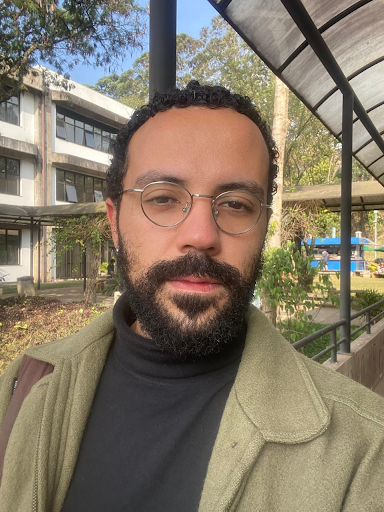
Ammar Bahadur Singh

Postdoctoral researcher,
Department of Educational Sciences and Arts
Mälardalen University, Västerås and Eskilstuna, Sweden
Email: ammar.singh@mdu.se or abs.sireta@gmail.com
https://orcid.org/0000-0003-4394-7571
https://www.mdu.se/en/malardalen-university/staff?id=ammar.singh
Research profile
Ammar Bahadur Singh is a postdoctoral researcher in higher education pedagogy. He holds a PhD in education with focus on digital/online pedagogy from the University of Oslo. His work critically examines social and collaborative learning, human and technological agency, and epistemic practices in digitally mediated environments. The central focus on his study is how agency in teaching and learning emerges in and through collaborative activities and how technologies assist participants in enacting and developing their agency in collaborative meaning making practices. He has good experience in designing, facilitating, and researching online and blended learning environments, with a particular focus on how pedagogical designs shape agency, knowledge construction, and professional identity in higher education.
List of publications
- Singh, A. B. (in press). Perspective: Integrating AI in massive open online courses: Teachers’ roles in facilitating human–AI collaboration and critical engagement in MOOCs. In Y. Jian-Hong (Ed.), Implementation strategies and effects of massive open online courses. IntechOpen.
- Joshi, D. R., Khanal, B., Chapai, K. P. S., & Singh, A. B. (2026). Role of secondary school students’ AI acceptance in mathematics learning in shaping academic achievement. Social Sciences & Humanities Open, 13, 102235. https://doi.org/10.1016/j.ssaho.2025.102235
- Singh, A. B. & Engeness, I. (2025). Co-agency and co-development in higher education. Human Arenas. https://doi.org/10.1007/s42087-025-00526-6
- Joshi, D. R., Singh, A. B., Chapai, K. P. S., & Joshi, B. M. (2025). Digital literacy matters: Analysis of PISA data 2022 on how literacy, confidence, and resource use shape math achievement. Mathematics Education Research Journal. https://doi.org/10.1007/s13394-025-00546-z
- Singh, A. B. (2025). Exploring the Symbiotic Relationship between Dialectics and Dialogical Approaches to Education in the Era of Artificial Intelligence: A Philosophical Perspective. Journal for the Philosophical Study of Education, Vol. 5
- Joshi, D. R., Upadhayaya, P. R., Chapai, K. P. S., & Singh, A. B. (2025). Digital Pedagogical Competency Framework for Teacher (DPCFT) for 21st Century Teachers. Preprints. https://doi.org/10.20944/preprints202502.1877.v1
- Singh, A. B. (2024). Digital technologies and student engagement in online synchronous collaborative learning sessions. Culture and Education. https://doi.org/10.1177/1135640524129298
- Chapai, K. P. S., Joshi, D. R., Singh, A. B., & Khadka, J. (2024). Role of students’ academic procrastination in shaping mathematics achievement. Education Inquiry, 1–27. https://doi.org/10.1080/20004508.2024.2418151
- Singh, A. B. & Mørch, A. (2024). Instructors’ epistemic intervention strategies in MOOC discussion forums. Journal of Educators Online, 21 (1). https://doi.org/10.9743/JEO.2024.21.1.5
- Singh, A. B. & Haugsbakken, H.G.S. (2023). Engendering collaborative transformative learning in an institutional xMOOC. In Rómulo P., Cathrine T., Linda B., Lise D., & Lars G. (Eds.) Digital transformation in higher education. Springer.
- Singh, A. B. (2022). Examining students’ collaborative epistemic actions in a MOOC learning environment. Journal of University Teaching & Learning Practice, 19(4). https://ro.uow.edu.au/jutlp/vol19/iss4/19
- Singh, A. B. (2022). Making Sense of Collaborative Learning Practices in the ICTPED MOOC. In M. Ranieri, L. Menichetti, S. Cuomo, D. Parmigiani, and Marta Pellegrini (Eds.), ATEE Spring Conference 2020-2021. Book of Abstracts (pp 235-238). Italy: Firenze University Press.
- Singh, A. B. (2022). Students’ Collaborative Epistemic Strategies in a MOOC Learning Environment. A paper presented at World Education Research Association Conference 4/22/2022. https://doi.org/10.3102/1897118.
- Singh, A. B., & Engeness, I. (2021). Examining Instructors’ Roles in Facilitating Students’ Learning Process in Pedagogical Information and Communication Technology Massive Open Online Course. Cultural-Historical Psychology, 17 (2), 76-89. https://doi.org/10.17759/chp.2021170208
- Engeness, I., Nohr, M., Singh, A. B., & Mørch, A. (2020). Use of videos in the Information and Communication Technology Massive Open Online Course: Insights for learning and development of transformative digital agency with pre-in-service teachers in Norway. Policy Futures in Education, 18(4), 497–516. https://doi.org/10.1177/1478210319895189?
- Singh, A. B. & Mørch, A. I. (2018). An Analysis of Participants’ Experiences of Learning from the First International MOOC Offered at the University of Oslo. Nordic Journal of Digital Literacy, 13 (1), 40-64. https://doi.org/10.18261/issn.1891-943x-2018-01-04
- Singh, A. B. (2018). Assessing the role of massive open online courses (MOOCs) in higher education: opportunities and challenges for learning. In M. Corneli et al. (Eds.), NELTA ELT Forum, 4, 97-113. https://neltaeltforum.wordpress.com/2017/06/02/1221/ammar/?
- Singh, A. B. (2016, June 24). Learning through MOOCs. Higher Education Development Association. http://uv-net.uio.no/wpmu/hedda/2016/06/24/guest-blogger-learning-through-moocs/ .This blog article summarizes my master’s thesis and discusses the potential for innovation in pedagogical practices in online higher education, specifically in the context of online courses.
- Singh, A. B. (2014, November 21). Tuition fees for non-EU/EEA students in Norway: Who will bear the brunt of it? Higher Education Development Association. http://uv-net.uio.no/wpmu/hedda/2014/11/21/student-blogger-tuition-fees-for-non-eueea-students-in-norway-who-will-bear-the-brunt-of-it/. This blog article discusses the nuances of tuition fees in Nordic countries and how Norway wants to impose discriminatory practices on students from so-called third countries.